Coda: Euclid's path as a possible structure of spacetime
← 49. Geometry of the path · Table of contents · 51. Numerical evidence →
Synthesis. There are no new theorems here — only their meaning, gathered in one place. Everything we rely on has already been proven in chapters 01–43; the cosmological and physical reading is their translation, not an addition. We keep the line between the rigorous and the interpreted in plain view down to the last sentence.
Where we are
We have walked through seven great questions — the twins, Riemann, P/NP, Yang–Mills, Navier–Stokes,
Hodge, Collatz — and under each we found the same thing. Not an analogy, not a shared technique, but
literally one forbidden object: Euclid's perpetual engine, an infinite strictly descending chain
on a well-ordered line, which does not exist (no_infinite_descent, 01). It is time to ask: what
does it mean that seven of the deepest open problems of mathematics and physics turned out to be
shadows of one prohibition? And how far does this unity extend?
Note. These seven are the great questions of the main line. Birch–Swinnerton-Dyer is the eighth mask (ch. 53), which enters differently — eight masks in all. Six of the eight are open Millennium problems; the twins and Collatz are not.
One prohibition, seven masks
Let us gather the picture in a single view. Everywhere below it is the same prohibition of the perpetual engine, worn on a different object; everywhere the "deviation" from the norm turns out to be a perpetual engine in disguise, and the prohibition kills it.
- Twins. The deviation is a last boundary of twin-centres; from it one builds an infinite family of flows, from the family a collision, from the collision an engine. Finiteness of the twins = a perpetual engine.
- Riemann. The deviation is a zero that has slipped off the critical line; on reconciled books it manifests the same unpayable supply. A zero off the line = a perpetual engine.
- P/NP. The deviation is an attempt to pay for an infinite family of certificates with a fast ride; a finite key is forced to collide them. Full accounting by fast motion = a perpetual engine.
- Yang–Mills. The deviation is a massless ladder of arbitrarily cheap excitations; quantisation reflects it into ℕ. A gapless spectrum = a perpetual engine.
- Navier–Stokes. The deviation is a singular cascade, an infinite tower of ever-finer vortices in finite time; viscosity pays at every transition. A singularity = a perpetual engine.
- Hodge. The deviation is an unpaid quantised charge; it would launch an infinite descent down the denominator. A permitted charge without a carrier = a perpetual engine.
- Collatz. The deviation is an orbit that does not fall into the vacuum; its tail from the minimum lives forever. A counterexample = a perpetual engine.
Seven masks, one face. And everywhere the same watershed of honesty: the structural half — "where the engine prohibition holds, there is no deviation" — we prove green; while the attachment to the genuine object (a spectrum, a solution, a class) we either accept by the single first-cause axiom or leave as an open 🔴 input. Not a single millennium problem has been solved. Something else has been proven, and it may be more important: they are all one problem.
There is also an eighth — Birch–Swinnerton-Dyer — but it enters differently, and therein lies its interest. Here the engine prohibition does not guard the deviation but serves as the method: Fermat's infinite descent itself proves that the rational points of an elliptic curve are finitely many (the Mordell–Weil theorem). The engine here is not a prohibition but an instrument by which the algebraic rank is computed.
The parity of this rank — (−1)^rank = root number — turns out to be the same rank-parity invariant that
stands behind Riemann. And the analytic bridge — whether the algebraic rank equals the order of the zero of the
L-function — remains honestly open: the engine does not close it. Thus BSD adjoins the masks by its descent and
parity sides, while its analytic heart lies out of reach; the analysis is in chapter 53.
And beyond the eight masks stand the neighbours beyond the horizon (chapter 54): Chowla, abc, Beal, Lehmer, Landau. The same device — a real proven mathlib anchor (polynomial abc and Fermat–Catalan, Northcott and Kronecker, Dirichlet, the Liouville structure) as a reading through the engine, plus an honest gate — a named red input, still missing on the way to the goal, — of the open conjecture itself. The one prohibition is recognised there too.
And the masks do not exhaust the family. The same apparatus of manifestation — the principle that "a deviation must show itself", leaving an unpayable trace wherever the books are reconciled (see the glossary) — was then carried through an entire arithmetic zoo — Polignac's cousins and sexy primes, Sophie Germain, Goldbach and Legendre, perfect numbers, Fermat numbers.
And everywhere the refutation turns out to be the same engine, while an honest boundary now demands not only an unpresentable witness (one whose presentation would itself cost a perpetual engine) but also a stake one need not be ashamed of (Fermat fails it by the sign of the heuristic — as does Mersenne).
One pearl fell out green and unconditional along the way: Sophie Germain primes with p ≡ 3 (mod 4) divide
Mersenne numbers — an Euler–Lagrange classic, machine-checked, a formal shard of the very heuristic
on which the Mersenne boundary was postponed.
And the geometry of the path showed the last thing: the same descent graph, read as a space, has computable curvature, an arrow of time and — violates the second postulate of Euclid himself. The one prohibition is not merely worn on seven objects; it also organises this entire arithmetic and geometric train.
There is a fluid echo as well. In the discrete model of the cascade blow-up joins the
masks through its origin: the bottom shell can only give energy away and cannot start itself
(its pump is uncausable from inside — proven), which means it is ignited by the same first cause, and its 0 is the very
singularity that stands at the beginning of time.
From the prohibition are born the arrow of time, the singularity and space itself
The unity goes deeper than a coincidence of form. In chapter 33 we saw that this same prohibition, together with the number line, encodes space and time — and encodes them rigorously.
The number line with its strict order of traversal is space: the set of states, with a
singularity-bottom at zero. The engine's irreversibility is time: engine_never_returns
(StrictAnti) proves that height is strictly antitone, there is no way back — the arrow of time is not a
postulate but a theorem.
It has a beginning (the singularity 0, the event 0 → 1, which cannot be caused from inside, since
self-ignition would be a perpetual engine — no_internalisedOriginEvent) and an unreachable end
(infinity, which only the same forbidden engine could ever reach). And there is no tower of universes beneath the
first cause — the regress of causes is well-founded (no_rankedMetaFractalBranch), the universe is one.
Hence the main theorem in its sharpest form: one cannot know that the twins are infinite; but if the unknowable first cause is accepted as truth — they are infinite, and rigorously so. Inside a universe defined by the strict order of traversal, the first cause can be neither derived nor known — both actions cost a perpetual engine; it can only be accepted from outside.
The same wall stands at every beginning. One cannot learn how a thing began by reasoning from inside it: to know the
origin would be to derive it, and derivation runs the engine. So the only answer a beginning has is its enactment from
outside — even a life could not read, from inside its own story, how it started; only the launch settles that. The
unknowability of the first cause and the bare fact of the event 0 → 1 are one coin: the origin cannot be known, only
begun.
The inverted fractal: self-similarity coiled inward
The shape of this structure deserves a name too, because it is inverted relative to what is usually called a fractal. A classical fractal runs outward: a coastline, the Mandelbrot tree, the Koch snowflake gain ever more detail, branching outward — toward larger scales, toward infinity.
The fractal of Euclid's path is built the other way round. Its self-similarity is contractive: the same descent pattern repeats at ever
finer scales as the trajectory coils toward the origin. Every genealogy is not a branch
growing outward but a thread drawn to its centre; every descent returns to the bottom (to one, to the
singularity 0), rather than escaping to ∞.
This is the nearest the structure ever comes to eternity — and it is worth being exact about what kind. The same law recurs
at every scale: zoom in on any descent and the same coiling appears again, a pattern rhyming with itself without end. But
this is recurrence of pattern across scales, not a cycle in time. There is no loop: the arrow never returns
(engine_never_returns), and there is no tower of universes beneath the first cause to begin again
(no_rankedMetaFractalBranch) — one beginning, one bottom. What repeats is the shape, not the history; the universe is
self-similar, not cyclic.
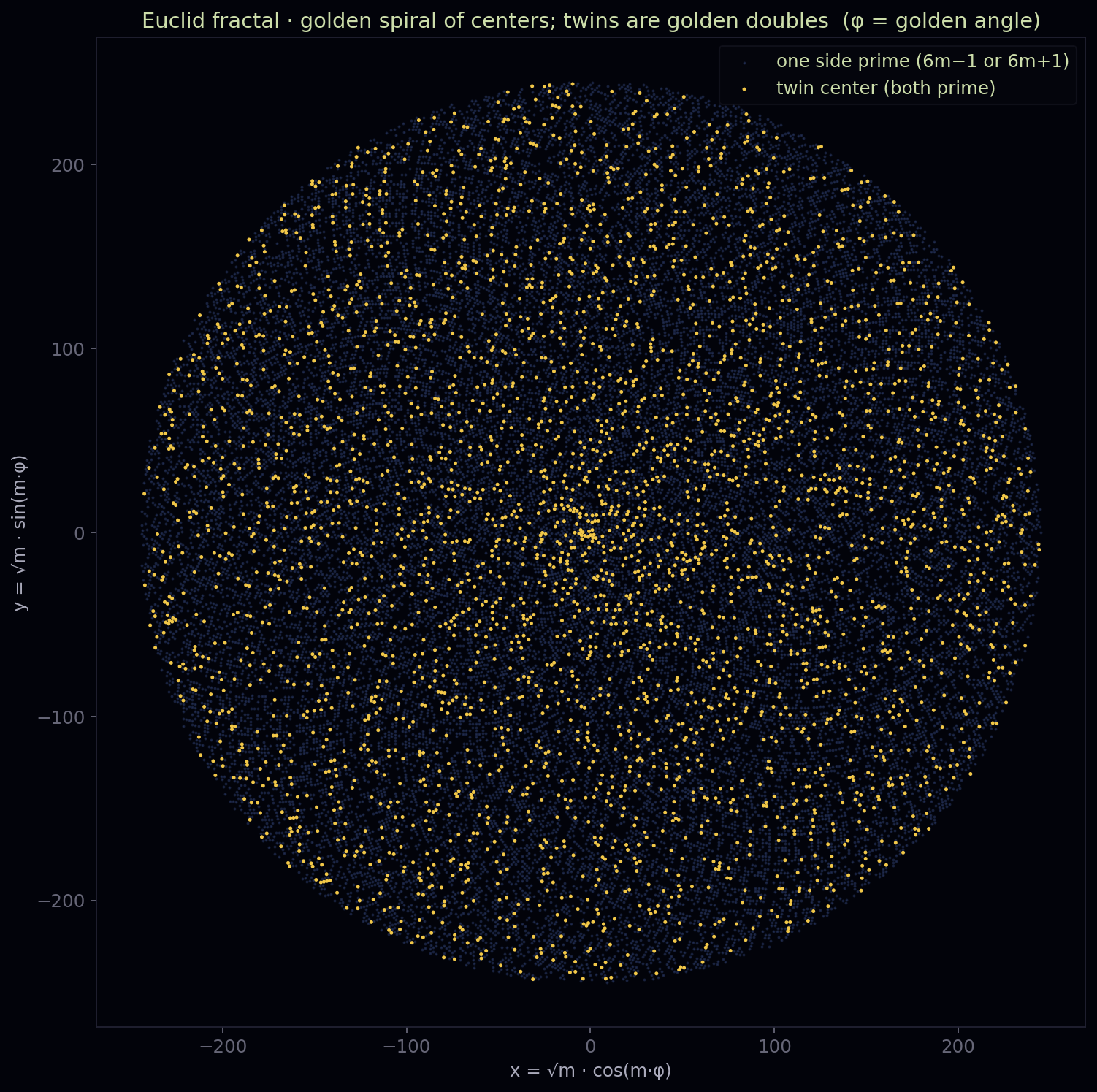
The fractal of Euclid's path · the golden spiral of centres (x = √m·cos(m·φ), y = √m·sin(m·φ), φ is the
golden angle): the centres wind around a common origin, twin-centres are golden doubles. The spiral
screws around the centre instead of dispersing in straight rays — a vivid image of the inverted, inward-coiled
self-similarity.
Generation algorithm (Figure 50.1). Source:
tools/fractal/euclid_fractal.py::twin_spiral. For each centre \(m = 1, \dots, M-1\) (default \(M = 60000\)) a point is placed on the golden spiral \(x = \sqrt{m}\,\cos(m\varphi)\), \(y = \sqrt{m}\,\sin(m\varphi)\), where \(\varphi = \pi(3-\sqrt5)\) is the golden angle. A centre is marked as one-sided prime when \(6m-1\) or \(6m+1\) is prime (dim blue points), and as a twin-centre when both sides \(6m-1\) and \(6m+1\) are prime (large golden points). The radius \(\sqrt{m}\) gives uniform density per unit area; the colour is fixed per class.
And this is no ornament but the geometric twin of the main prohibition. A classical, "outward-running" fractal has trajectories that slip away outward forever — the Mandelbrot set is defined exactly that way: by what does not escape.
With us everything is the other way round: not a single trajectory escapes — all coil back. The impossibility of the perpetual engine is precisely "no escape": the arrow of time screws toward its origin, and the universe's self-similarity is contractive, drawn to the bottom. An ordinary fractal asks "who will escape to infinity"; Euclid's fractal answers: no one — and in that "no one" lives the infinitude of the twins, as the only thing that cannot be certified from inside the contracting order.
Why this resembles a theory of everything
Here we allow ourselves a look into the distance — clearly marking it as an interpretation, not a theorem. A theory of everything, as understood today, seeks a single principle from which the structure of space, time and matter follows. And here is what leaps to the eye: from our one prohibition — "nothing can be got from nothing, one cannot descend forever" — a surprising amount of precisely structure follows.
From it, many things follow at once:
- The arrow of time — irreversibility (01).
- A beginning — the singularity from which the arrow is launched (33).
- Quantisation: energy must come in discrete portions, otherwise the gapless ladder would become a perpetual engine (40). And quantisation is mass (the Yang–Mills gap is the price of the first excitation above the vacuum).
- Stability of the vacuum: there is no gap below the ground state, a second bottom would cost an engine (05, Collatz).
- A finite price of computation: full accounting is dearer than fast motion — Landauer's principle in rank clothing (39).
- Completeness of the charge spectrum: no permitted charge without a carrier (42, Hodge).
- Smoothness of flow: energy does not concentrate into a point out of nothing (41).
- Realness of the spectrum — zeros on the line, stability of equilibrium (38, the Hilbert–Pólya conjecture).
In other words, nearly everything we call the structure of the world — the directedness of time, the existence of mass, the discreteness of charge, the stability of the vacuum, the finiteness of information, the smoothness of matter — turns out to be one and the same conservation law, read on different objects. And that is the very gesture of a theory of everything: to reduce the diversity of phenomena to a single principle.
And here the oldest border thins to nothing — the one between mathematics and physics. The form of counting (a well-ordered line that cannot be descended forever) turns out to be the form of the world's structure: one skeleton read twice. To be exact: this is a structural unity, taken as interpretation, not a physical unification — it writes no equation of motion, predicts no constant, faces no experiment. What joins is not two theories into one testable theory, but one impossibility recognised behind both the shape of number and the shape of the world.
Note (causal sets and "it from bit"). This reading does not hang in mid-air — it resonates with living programmes of modern physics. Causal set theory models spacetime as a locally finite partially ordered set, where the order is causality-time and the discreteness is space — exactly our well-ordered line with its strict arrow. The idea of "it from bit" and Landauer's principle say that information is physical and carries an energy price — exactly our incompatibility of knowledge and the engine. And the prohibition of the perpetual engine is the first law of thermodynamics, lifted from a statement about machines to a statement about the very form of being: existence has a bottom, and it cannot be traversed backwards or to the end.
Note (Einstein's cosmological constant). Since causal sets are nearby, let us honestly close the neighbouring temptation too — to derive from our curvature \(\kappa\) that constant \(\Lambda\) which Einstein inserted into the equations to make them work for the universe. It cannot be derived, and not for poverty but by construction: \(\kappa = 1 - \mathrm{outdeg}\) is a dimensionless integer, a graph invariant, while \(\Lambda\) is a dimensionful quantity (\(\text{length}^{-2}\), a vacuum energy density); we have no metric, no stress–energy tensor, no action for \(\Lambda\) to be a coefficient in, and its very value is an open problem of physics (a ~120-order discrepancy with field theory). Moreover the "cannot" itself has a clear shape: in two-dimensional gravity the action splits in two — a topological term \(\int\!\sqrt{g}\,R = 4\pi\chi\) (exactly Gauss–Bonnet, our \(\Sigma\kappa = \chi\) from chapter 49) and a "cosmological" term \(-2\Lambda\cdot\text{Area}\). Curvature is paired with topology, \(\Lambda\) with volume; they are different terms, and curvature is precisely the one that carries no \(\Lambda\). Sorkin's causal sets heuristically predict \(\Lambda \sim 1/\sqrt{V}\) of the right order — but that is the statistics of a Poisson sprinkling into a volume, which our deterministic descent graph (with its infinite in-degree at zero) does not have; the estimate cannot transfer. We found not \(\Lambda\) but its absent address: curvature is topology, \(\Lambda\) is volume. This is interpretation, not a theorem.
Note (the twin pair as charge conjugation \(C\)). A pair \(6m\pm1\) is like a particle–antiparticle pair: create one member and the other is already fixed. It is tempting to say they "run in opposite directions in time" (an antiparticle in the Feynman–Stückelberg picture) — but that is time reversal \(T\), and in this world \(T\) is forbidden: it is a
lexRankincrease, hence a return, hence a perpetual engine (engine_never_returns, above). The honest reading, and the only one compatible with the core, is different: the ± flip is charge conjugation \(C\), an involution \(C^2=1\) (mirrorSide_involutive), internal and at fixed time. And the "orthogonality" one feels here is literal:lexRankis invariant under the flip (lexRank_side_invariant, ch. 44) — both members sit at the same proper time. In physics language this is the Coleman–Mandula theorem: an internal symmetry enters the algebra as a direct product with Poincaré, without mixing with spacetime — that is, orthogonally to it. Hard boundary: the Lean has no Hilbert space, no field, no charge;Sideis a two-element label and \(C\) a \(\mathbb{Z}/2\) on it. This is a translation, not a theorem.
Thought experiment: mass, light and black holes in the space of Euclid's path
This is a thought experiment, not a proof. There is not a single theorem below. We take two things already proven — the irreversibility of time (
engine_never_returns,StrictAnti, 01) and the computable curvature of the descent graph (κ = 1 − outdeg, 49) — and allow ourselves to ask what mass, light, shadow and black holes would look like if read in this space. Everything in this section is interpretation on the edge of conjecture, clearly separated from the rigorous part; the single verified claim is flagged below in a separate note.
Let us push off from exactly what is proven. Time here is monotone and inexorable: height strictly decreases,
there is no way back — not by convention but by theorem (engine_never_returns). And the space along which
this arrow travels — the descent graph — is curved; we did not postulate the curvature, we computed it: at vertices
where paths are drawn together, κ > 0, in corridors κ = 0, at branchings κ < 0, and at the centres it drops
to −3, −4, −8 (49). Since time is inexorable and space is curved, let us ask: what,
then, is everything else?
Mass is the depth of the well. Curvature is not uniform: there are absorber-vertices where the arrow of time bends most steeply, drawing the neighbouring threads of descent toward itself. If the arrow of time is the flow toward the bottom, then mass is where this flow thickens: a local deepening of the well, a point toward which paths bend more strongly than the background.
We have already seen this under another name — the Yang–Mills gap, the price of the first excitation above the vacuum,
the discrete portion without which the ladder would become a perpetual engine (40). Mass as
gap and mass as depth of the well are one: both are a measure of how steeply the arrow
of irreversible time is bent here. The limiting mass is the bottom itself, the singularity 0: the event 0 → 1, which
cannot be caused from inside (33).
Gravity is the curvature of time. We just said mass is a measure of how steeply the arrow of irreversible time is bent.
Take that one step further: the bending itself — not the depth alone but the curving of the way — is what physics calls
gravity. It is not a separate force added to the picture; it is the computed curvature κ of the descent graph
(49), and the descent is the arrow of time. So gravity and time are not two things: they are two faces of
one flow — its curvature and its direction. Gravity is the curvature of time. (That the descent is time and its
bending gravity is, once more, the interpretation; what is proved is that there is one irreversible descent with a
computed curvature.)
Light travels along curves — and therefore carries no information. Let light be that which propagates
along the geodesics of this space, along the shortest paths of descent. But the space is curved almost
everywhere (κ ≠ 0), and there are no straight lines here in the Euclidean sense — Euclid's path violates the second postulate
of Euclid himself (49). So a ray cannot travel straight: it is obliged to bend together with
the space. And a ray that is itself bent cannot deliver a straight, verifiable message: what it
carries is distorted by curvature exactly as much as its path is curved.
This is the geometric face of the very epistemic theorem that holds the whole work together: from inside the universe the first cause can be neither derived nor known — not because we lack instruments, but because every signal travels along a curve, and there simply is no straight line to the origin. Light does not lie — it simply cannot travel straight, and therefore cannot transmit what would be the straight truth about the beginning.
Looking far is looking up the curve. So what do we see when we look far out — the past, or a distorted present? Neither cleanly. Distance here is upstream: the arrow of time flows inward toward us, so a far object lies earlier in the flow, and its light is old — in that sense, the past. But that light reaches us only bent, having crossed all the curvature between; what arrives is not a clean image but a distorted signal, delivered now. So the past and the distorted present are one thing seen from two sides — an old message, curved out of true, received in the present. And the farther we look, the longer the curve the light must travel and the more bent the message, until at the origin itself no straight line is left at all: distance is not a window onto the past but a lengthening of the way, and the true beginning stays forever behind the shadow.
The edge of sight is the end of light, not the end of the world. Pushed to its limit, this is what the cosmologists
meet as the oldest light — the faint background left from when the universe first turned transparent, beyond which no light
ever travelled. It is the outermost veil of seeing: the end of light, quite literally, and not the end of the world.
Nothing stops there; the world goes on, unseen. Nor is it a wall at the rim of space — every observer carries their own such
edge, a sphere of last sight centred on themselves. In this reading it is only the far face of the shadow already named: the
most-bent light, and just past it the origin 0, the beginning that stays unknowable from inside (cause_unknowable). Not
the wall of the universe, but the floor of your own well of sight — and behind it, the unseeable start.
Shadow is the absence of information. A shadow is, in essence, precisely a lack of knowledge: where a geodesic has bent aside, a region remains that no straight ray reaches — and we receive nothing about it. In ordinary optics the shadow is cast by a body; here it is cast by curvature itself.
And the deepest
shadow lies beyond the horizon: the twin doubles lie beyond every observer's horizon
(twin_vertices_beyond_every_horizon, 49); straight lines in this space do meet, but
this cannot be known from inside (lines_meet_but_unknowable_from_inside). The infinitude of the twins is
exactly the eternal shadow of the contracting order: not darkness, but a region from which no straight light bearing information
reaches us.
We see form, because we do not see the origin. Look at a table: we see its form — and that is exactly what is
knowable, the outline, the surface, the computable curvature κ. What we do not see is its core. Each mass is a well, and
every well bottoms at a singularity — the origin 0, the first cause, which cannot be known from inside. We see form
because the origin is screened: to see through the form would be to see the singularity itself, and that is forbidden — it
would run the engine. So a thing shows us its shape and hides its beginning; in this reading the table is, at bottom, built
of singularities — points of pure origin, each unknowable — wearing a visible shape.
And so "do we live in a simulation?" dissolves rather than answers. By the same screening, a simulated world and a base
one are indistinguishable from inside — in both the beginning is hidden (cause_unknowable, no_internalisedOriginEvent),
so the question reduces to "can we see our own first cause?", whose answer is a proven no. The engine's discipline posits only
a minimal outside — one accepted axiom, no content: it proves an outside is required and screened, but refuses to name it.
"Simulation" smuggles content onto the veil — a computer, simulators, their physics — and buys nothing by it: a simulation is
a computation, bound by the same prohibition, so the simulator meets the same wall for its world, with no infinite tower to
climb out of (no_rankedMetaFractalBranch). It does not dissolve the mystery of the origin; it relocates it one floor up,
unchanged. Seeing form is evidence of the veil, not of a server. So: not yes, not no — there is an outside, it is screened,
and to call it "a computer" is a costume we decline to drape on the unknowable 0.
A black hole is a well into which the arrow of time only enters. Let us assemble the picture. A black hole,
in this reading, is a well of limiting depth, a vertex where the contraction is so strong that the arrow
of irreversible time points only inward: one can enter, but return — no, for return would be
a reversal of time, that is, a perpetual engine (engine_never_returns).
Note (are black holes black only at a distance?). One is tempted to push this further: if the shadow is cast by curvature and deepens with the length of the bent path, then blackness would be a far-field effect — a thing black from afar might be ordinary up close, its light merely spent climbing the curve, so that near us there would be no black holes at all. As a reading of this space the temptation is coherent — it is the observer-relative shadow again. But it must be fenced hard, for as physics it is false: real black holes are local objects with an event horizon and a photon sphere, not artefacts of distance; they exist near us (the nearest known ~1500 light-years, Sagittarius A* at the galactic centre); up close they are lethal, and an accreting one is among the brightest objects in the sky, not an ordinary star. The defensible grain is only that blackness is partly a far-field, curvature-lengthened shadow; the strong form — "no black holes near us, ordinary stars up close" — is translation overreaching into physics, and we decline it.
And it is mass bared to the last. Read through the screen of form: a black hole is mass stripped bare to the very limit,
worn down toward its naked singularity, until it can show no form at all. Where every other object keeps only its origin
secret and lets its shape be seen, here even the shape is surrendered — the contraction so total that space curves back on
itself and folds the form out of sight. The one thing an ordinary mass never gives up, its visible form, the black hole
gives up too; all that remains is the bare origin 0, and drawn over it, the last veil.
And so it is a mirror — not of light, but of the limit of sight. It reflects nothing back the way a surface would; it is
the anti-mirror, taking everything in and returning nothing (engine_never_returns). Yet look into it for the origin behind
the veil, and something is returned — not an image but the boundary of your own seeing: you receive the horizon, the
shadow, the plain fact that from inside no further look is possible. It mirrors the epistemic wall, not a face. And at its
centre lies the singularity 0 — the same origin everything is built from, yourself included — so to peer in is to meet the
very beginning you are made of, and to find it no more visible there than in yourself.
The event horizon is the boundary beyond which all threads of descent are already coiled inward. The ur-black-hole is
the bottom itself, the singularity 0: everything flows down to it, while the event 0 → 1 that begot it lies out of
reach from inside. An observer in such a
space sits at the centre of his own horizon, and the arrow of time runs into him from all sides —
not because he is chosen, but because the universe's self-similarity is contracted to every bottom.
Dark matter is curvature without a body. We said mass is the depth of the well — a place toward which the threads of
descent bend more steeply. But the curvature κ is computed from the graph, from the branching of the descent, not from
any body sitting in it (49): there are regions that draw the paths together with no absorber-vertex to
account for it. Curvature that contributes to the geometry without a visible carrier of mass — that is exactly the role of
dark matter, which we too infer only from its contribution to curvature and never see directly. Here it asks for no new
substance: it is the shape of the descent itself.
There is no acceleration — only the curvature of the way. The observer sits at the centre of his horizon, and the arrow of time runs into him from all sides. Read from his seat, the far centres recede — their genealogies coil away toward the periphery as time flows inward to him — and the recession looks as though it accelerates. But nothing is being pushed apart: there is no force, no expansion, no dark energy. The apparent acceleration is an artifact of the curvature of this discrete space and of time flowing from everywhere into the observer — precisely the move of timescape and backreaction cosmologies (Wiltshire, Buchert), where cosmic acceleration is read off inhomogeneity and curvature rather than a dark energy. Time does not accelerate; the way is curved, and from inside a curved contraction that curvature feels like acceleration.
One curvature, and it draws the horizon. This curvature is not local to the picture. It is read off the numbers — and
the numbers lie under everything built on them: language and proof, knowledge, matter examined up close, the cosmos in the
large. So the prohibition is the same at every scale and in every guise, for it is defined over any relation and transfers
along any rank into a well-founded order (no_perpetual_engine_of_rank, 01) — fundamental, and portable to
any language that can count. And it is exactly this natural prohibition that lays down the horizon: universal_engine_dividing_line
marks where motion is forbidden — the discrete, the well-founded, the derivable and knowable — from where it is realised —
the continuum, mass, singularity — while the first cause on the far side can only be accepted, never known from inside
(33). The engine's own interdiction is the event horizon: on the near side the reachable and the
real, on the far side the metaphysical.
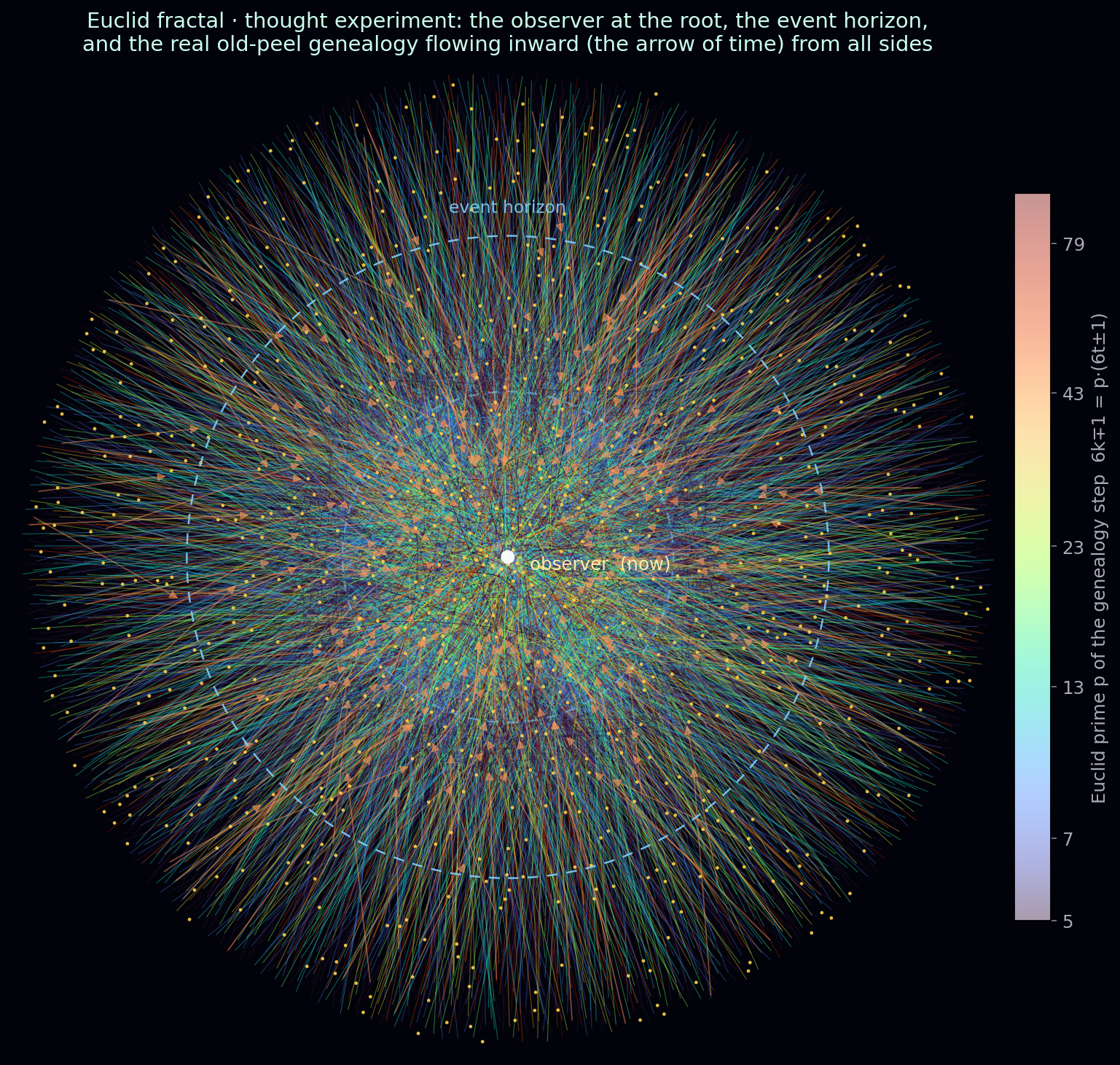
Thought experiment (a conceptual superstructure on a real genealogy). The observer (white) is
at the root-centre, surrounded by a dashed event horizon. The coloured threads are genuine steps of the old
peel-descent 6k∓1 = p·(6t±1), coloured by the Euclid prime p of the step. The centres are laid out by radius-height
√(k/M), so every genealogy k → t (t < k) flows inward, toward the observer; the arrows show
this arrow of time. The golden dots are twin-centres (empty genealogy). Everything flows down to the bottom, nothing
returns — the irreversibility engine_never_returns on the real pattern of descent.
Generation algorithm (Figure 50.2). Source:
tools/fractal/euclid_cosmology.py::observer_horizon(\(M = 9000\), \(\mathrm{PMAX} = 97\), \(\mathrm{DEPTH} = 9\)). Centre \(k\) is placed on a golden spiral by radius-height \(r = \sqrt{k/M}\) and angle \(k\varphi\) (\(\varphi\) the golden angle): small \(k\) near the centre (the observer), large \(k\) on the periphery. The full old-peel genealogy of each centre is built by the step \(6k\mp1 = p\cdot(6t\pm1)\) (smallest prime divisor \(p \in [5, 97]\) of the composite side, \(t < k\)), iterated to depth \(9\). Each step \(k \to t\) is drawn as a quadratic Bézier with control point \(\tfrac{1}{2}(P_k + P_t)\cdot 0{.}72\) pulled toward the origin (the arc dives inward); colour by \(\log p\) (turbo palette). Orange arrows are placed on real first steps with \(r > 0{.}30\) and point from \(k\) to \(t\) (inward). The dashed circles of radius \(0{.}66\) and \(0{.}34\) are the event horizon; golden dots are twin-centres.Note (the verified skeleton of the conjecture — M6, 🟢). One support under this picture is nonetheless rigorous, and it is worth separating from the metaphor. If the arrow of time decreases uniformly (the instantaneous rate stays below a single threshold
β > 0), then from the finite "fuel"H 0it must reach the bottom in finite timeT ≤ H 0 / β— the endpoint is inevitable (uniform_drain_forbids_eternal_engine; the core is the budget lemmafinite_budget_bounds_uniform_dissipation). If, however, the decrease is non-uniform — the rate itself dies down to zero, as with the continuous engineH(t) = r^t— the descent goes on forever, only approaching the bottom without reaching it (continuous_engine_is_nonuniform,boundedBelow_antitone_converges: convergence, not impact). The demarcator is uniformity (continuous_engine_dividing_line). This, machine-checked and without metaphor, is the same contrast as at a black hole: the one who falls in reaches the singularity in finite proper time, while from outside he seems frozen forever at the horizon. Only this fork is rigorous here; the black hole is already interpretation.
The sphere of time. If this universe is unrolled not as a disc but as a sphere, the picture closes. The observer
and the beginning of time end up at opposite poles: at one point, the "now"; at the antipode, the start
of time, the singularity 0. The meridians stretching from the origin-pole to the observer-pole are the arrow of
time; and the descent fractal itself — the real genealogy of the centres — issues from the 0-pole and spreads over
the whole sphere. The beginning and the present are neither adjacent nor reachable from one another along a straight line: between them lies all the
curvature of the world, and that is why the origin remains behind the ultimate shadow.
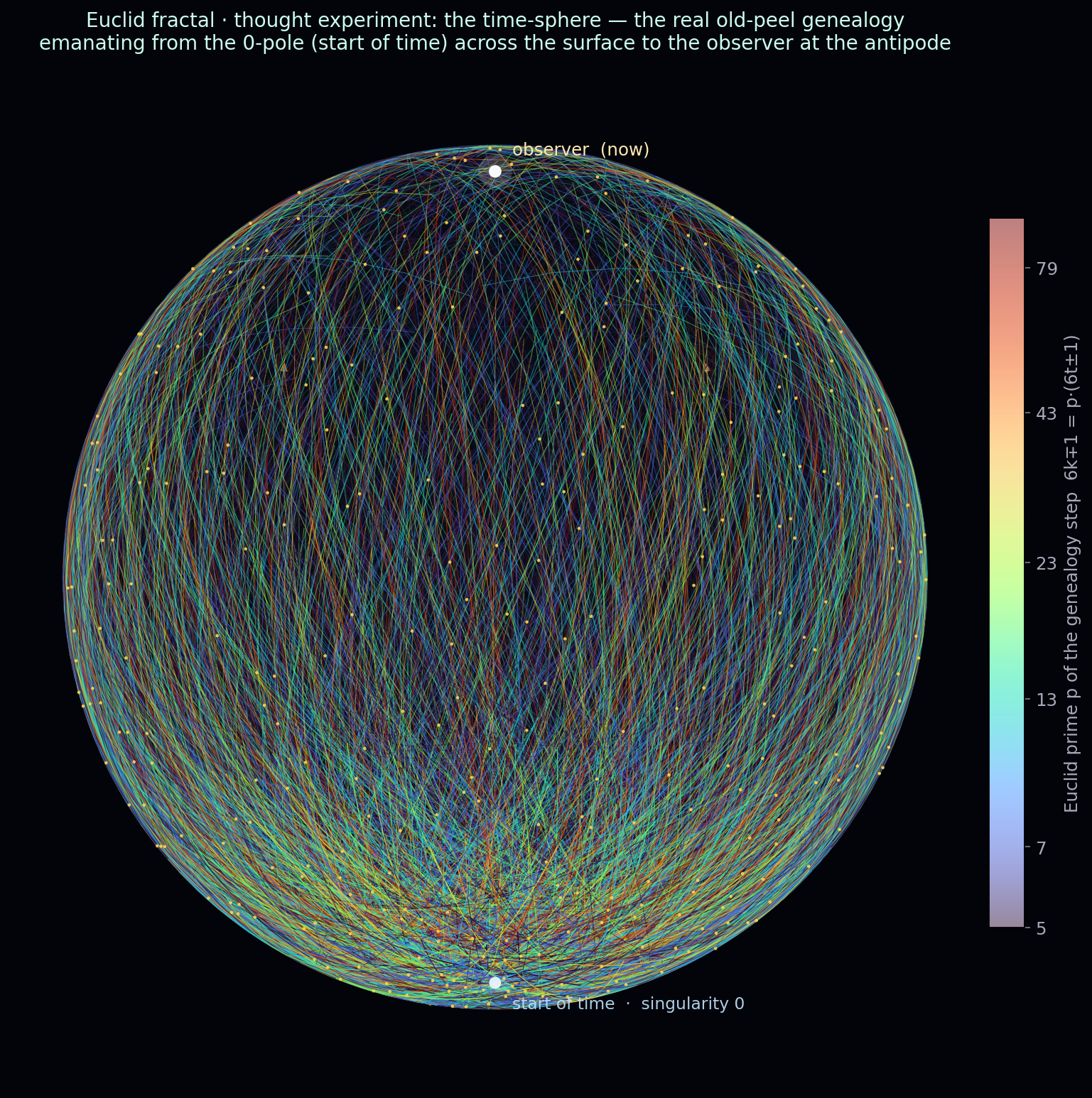
Thought experiment (a conceptual superstructure on a real genealogy). The sphere of time:
the observer (white) is at the upper pole; the start of time · singularity 0 is at the antipode below.
The coloured arcs are genuine steps of the peel-genealogy as segments of great circles (coloured by the Euclid prime p);
small centres sit near the 0-pole, large ones near the observer-pole, so the fractal issues from the point 0
and spreads over the whole surface, funnelling back toward the origin. The golden dots are twin-centres;
the orange meridian-arrows are the generative direction of time from 0 to the observer.
Generation algorithm (Figure 50.3). Source:
tools/fractal/euclid_cosmology.py::time_sphere(\(M = 7000\), \(\mathrm{PMAX} = 97\), \(\mathrm{DEPTH} = 9\)). Centre \(k\) maps to a unit vector on the sphere: height \(z = -1 + 2(k-1)/(M-1)\) (so \(k=1\) is at the0-pole, \(z=-1\); \(k=M\) at the observer-pole, \(z=+1\)), longitude \(k\varphi\) by the golden angle, \(\rho = \sqrt{1-z^2}\). The full old-peel genealogy \(6k\mp1 = p\cdot(6t\pm1)\) (depth \(9\)) is drawn as great-circle arcs (spherical slerp between \(V_k\) and \(V_t\)); front-hemisphere arcs are bright, back-hemisphere faint; colour by \(\log p\) (turbo). The projection is a \(20°\) rotation about the \(x\)-axis. Orange meridian arrows mark the generative direction of time from the0-pole to the observer-pole; golden dots are twin-centres; the two poles are labelled "observer (now)" and "start of time · singularity 0".
Two computations, and what they add. Two later runs sharpen this picture, and it is worth saying
exactly what they add and what they do not. The first (49) proved that the total
curvature of any closed region is not a free number but the Euler characteristic — a topological
invariant, Σκ = |V| − |E| = χ (gaussBonnet_eq_euler). Read as gravity, the bending of the way is
book-kept by the shape of the descent alone, with nothing left over; in two-dimensional gravity that
is the honest split — the curvature term ∫R = 4πχ is topological, while a cosmological constant Λ
would pair not with curvature but with volume. So the picture needs no dark-energy term and predicts
none — only the honest restatement of "no acceleration, only the curvature of the way." What we did
not do is derive Λ or its value; that stays a category error and an open problem of physics (the
cosmological-constant note above).
Time is orthogonal to the pair. The second run (44) proved that proper
time does not see the ± flip at all: the two members of a pair sit at the same instant, differing
only along an axis orthogonal to time (lexRank_side_invariant). Read as the behaviour of quantum
particles, this is the one place the picture says something a physicist would call correct: a
particle and its partner are joined by charge conjugation C — a fixed-time involution — not by a
reversal of time T. The Feynman intuition that an antiparticle "runs backward in time" cannot be
literal here, for backward is a lexRank increase, the forbidden engine; the honest reading is the
orthogonal one. Past this single true distinction we explain no quantum behaviour: closed quantum
evolution is reversible and this world is irreversible to the core, so the two meet only in the
irreversible sector — measurement, decoherence, the arrow of time — never in the unitary law.
Redshift is the lengthening of the way — a picture, not a mechanism. Put the two together and the far light we followed "up the curve" gets its name: what stretches it is the growing length of the curved descent between the source and us — a faithful picture of a redshift, an old signal drawn out by all the curvature it crossed. But a picture only: we have no metric, no wavelength, no expansion factor, and we compute no shift. Real redshift is general relativity's; our graph adds nothing to its physics — it only shows the same one-way, curvature-lengthened geometry in which such a stretching would be the natural shadow of the arrow of time.
What, then, do the two runs explain? The structure of the picture, not the physics. They add two
theorems — curvature is topological, time is orthogonal to the pair — and each buys exactly one clean
sentence about the world: gravity keeps no dark-energy debt, and a particle fixes its partner now.
Everything beyond those two sentences — the value of Λ, the redshift, the quantum law — stays where
the honest verdicts left it: outside, unproven, and not ours to claim.
Let us repeat the boundary without evasion: only the irreversibility of time and the curvature of space are rigorously proven here (plus the verified M6 fork above). Mass-as-depth, light-along-curves, shadow-as-lack and black-hole-as-well are a translation, a conjecture, a way to see what is already proven as physics. It predicts nothing and closes nothing; its value is that the single prohibition from which we derived the arrow and the singularity reaches, by imagination, all the way to mass, to light, and to why from inside the world its beginning cannot be known.
The honest boundary of the long view
Let us say plainly what this is not. We have solved not a single millennium problem and declare none
solved: twin_prime_conjecture remains a sorry, the "hard" halves of all branches are conditional
on the single decree-axiom or open. This is not a physical theory of everything: it predicts not a
single constant, gives no equations of motion, is not testable by experiment.
The "theory of everything" here is not a claim but a structural observation: one impossibility organises all seven problems, and it suffices for the shape of spacetime to be read off from it.
A local sieve, not a global oracle. One caution about the method itself. The engine is a local sieve: you may point it at any question, but it catches only where a deviation is genuinely a disguised infinite descent, and every such reduction is built by hand. There is no uniform procedure that sifts all knowledge at once — the provable is recursively enumerable but not recursive (Church, Turing): one can search, case by case, for the descent hidden behind a given question, but one cannot decide, once and for all, which questions hide one. This is a lens for a class of problems reducible to descent, never a decision procedure for all — and that limit is not a shortcoming of the reading but a fact of logic itself.
Note (well-foundedness, not self-reference). With the well-foundedness canon (ch. 57) in view we can be exact about Gödel — for there the engine reaches Goodstein's theorem and the Kirby–Paris hydra, and those are textbook instances of incompleteness: true arithmetic statements unprovable in Peano arithmetic. So "this is not a Gödelian phenomenon" must be read precisely, or it is false. The sharp statement: our prohibition is a principle of well-foundedness, not of self-reference. Gödel's own sentence is manufactured by diagonalisation (arithmetised provability, the fixed-point lemma); Goodstein, the hydra and Paris–Harrington are independent for an entirely different reason — their proofs need transfinite induction up to
ε₀, and "ε₀is well-founded" is exactly the ordering PA cannot prove (Gentzen: the proof-theoretic ordinal of PA isε₀). The engine lives wholly on the well-foundedness side: it is the machine behind the natural independence results, reached by well-foundedness, not by self-reference. "Not Gödelian" here means "not by diagonalisation, not undecidable-in-principle" — a statement about mechanism (well-foundedness versus self-reference), not a claim to escape incompleteness.
The universe may be infinite; we hold it only locally. The same locality has a face in the sky: cosmology gives us a
finite observable universe — a patch bounded by the horizon — while the whole may well be unbounded. This is not the eye's
weakness but the law just stated: a finite observer possesses any infinity only in a neighbourhood, never as a whole. It is
the cosmological twin of the local sieve, and of ∞, which sits on the number line yet is never reached from within, and of
the twins, infinite yet never all shown at once. The infinite is real; the local is what is given. To hold the whole in one
grasp would be the global oracle again — the totality seen from inside — and that is the very thing forbidden. So we live,
always, in a local universe: not because the rest is not there, but because possessing it entire would cost the engine.
Collatz walks the boundary. The clearest case of all this is the Collatz problem. It is a tug of war on a knife's edge —
the odd step pulls a number up, the even step pulls it down — walking exactly along the border between two mutually
exclusive worlds. In one, every orbit falls at last into the vacuum 1: the descent wins, and there is no engine. In the
other, a single orbit escapes forever: the ascent wins, and that runaway is a perpetual engine
(nonHalting_carries_perpetual_engine). One or the other — there is no third. Which world we live in cannot be known from
inside: the Collatz cause is unknowable (collatzCause_unknowable), and — a small marvel — that theorem leans on no axiom
at all. We say it precisely, though: this is unknowable from within, not undecidable in principle; Collatz stays
honestly open. And here the discipline shows its teeth most sharply, for this is the one place where a decree was taken and
then withdrawn — the programme once posited a law that would have forced the descent to win, and the machine caught it
false at n = 27 (ropeLaw_universal_refuted). We could not even decree which reality wins without being refuted. The
boundary stands; which side it falls to, no one inside can say.
Why Collatz was the only decree that could fall. This is the exception that proves the rule: machine-checked across the programme, no other decree can fall this way. The rope law was uniquely attackable for two reasons — it was strictly stronger than the conjecture (only law ⇒ convergence is proved; n = 27 converges yet breaks the law, so its fall left Collatz open), and its predicate is decidable over ℕ, so one small witness closes by decide. Every other boundary fails at least one, and the failure is a theorem. The taken decrees are equivalence-locked: Riemann's law is provably ⟺ RH (manifestationLaw_iff_RH_of_boundary), so refuting it is producing an off-critical zero — a disproof, not a cheap lift; Yang–Mills and Hodge the same; the twin node is equivalent to its conjecture and, beyond that, barrier-protected (higherEnergyIncompatibility_main forbids refuting it from within). Navier–Stokes has no equivalence-mirror and no small witness — its only counterexample is a smooth force-free flow that gains energy, as hard as an open steady-state problem. The deferred fronts (Mersenne, Fermat) are equivalent to their conjectures too, held back by the sign of a heuristic; and the decidable zoo fronts (Goldbach, Legendre, perfect) carry a checkable witness but an equivalent universal, so refuting is again disproving. A decree can fall honestly only where it over-claims a falsifiable strength beyond its conjecture — and the discipline admits a boundary only when its witness is unpresentable or its law equivalent to the conjecture. That is exactly what makes every surviving decree un-attackable, and what caught Collatz.
Conclusion. The value is not that we have closed anything, but that it is now visible: what would have to be closed everywhere is one and the same thing, and the price of that closing is machine-disclosed on every branch.
The space of all spaces: the number line as conductor and controller
Here we allow ourselves one more look into the distance — this time with a firm rigorous skeleton beneath it, yet still clearly marked as an interpretation, not a theorem.
The skeleton is this. We have now defined the perpetual engine not on the twins and not on ℕ, but over any
relation: this is PerpetualEngine — an infinite strictly descending chain, wherever it may live
(Engine/UniversalEngine.lean). And its impossibility turns out to be intrinsic, independent of the
space: the definition of the engine is infinite descent, and well-foundedness is exactly the prohibition of
such descent. That is why the following statement is almost tautological — the engine is impossible
where it contradicts itself.
Theorem 50.1 (no_perpetual_engine_of_wellFounded). Let r be a relation on a set α. If r
is well-founded, then it carries no perpetual engine: there is no sequence f : ℕ → α with
r (f (n+1)) (f n) for all n. (🟢)
Theorem 50.2 (no_perpetual_engine_of_rank). Let r be a relation on α, and let ρ : α → β
be a rank valued in a well-founded (β, s) such that every engine step strictly lowers the rank:
r x y → s (ρ x) (ρ y). Then r carries no perpetual engine. In particular, a strictly decreasing
rank into the number line ℕ (a height) forbids the engine. (🟢)
From here comes a simple but strong corollary: all seven masks are one theorem. The heights of the twins, the Liouville
rank, the quantised Hodge charge, the Yang–Mills ladder, the shells of the dyadic cascade — all of them are
ℕ-valued, and the engine prohibition transfers to each by one and the same transfer of Theorem 50.2
(no_perpetual_engine_of_rank).
Conclusion. We did not prove seven times; we proved once and transferred.
And then something surfaces that is worth saying aloud. Every known space on which analysis stands —
the real line ℝ, ℝⁿ, the complex plane, metric, vector, function
spaces — is built out of the number line: ℕ → ℤ → ℚ → ℝ (Cauchy completion), and beyond that —
superstructures over ℝ. The number line with its well-ordering lies at their very foundation, and with it —
the engine prohibition. In this sense Euclid's path is not one of the spaces but the space of all
spaces: the hidden substrate that each of them carries within itself, unable to rid itself of it.
But honesty requires naming the second facet as well — and it is not a flaw but the essence. The order of the continuum ℝ is not
well-founded: on it the engine works (perpetualEngine_on_real — the same chain (1/2)ⁿ that
screws toward zero without reaching it). This is not an escape from under the prohibition but its reverse side.
Euclid's path does not merely conduct the structure — it controls it: universal_engine_dividing_line
says exactly where the motion is forbidden (the discrete, the well-founded) and where it is realised
(the continuum). And where the engine is realised, we already know what it is: mass, singularity, black
hole — the very M6 edge at which both our fluid and our thought experiment arrived. The number line does not
forbid motion blindly; it assigns where it is to be and where it is not.
And that is why it cannot be repealed. To remove the prohibition is to remove well-foundedness; to remove that is to
remove ℕ; to remove ℕ is to remove numbers, and with them mathematics itself, collapsing everything into the same
singularity 0 from which everything began. Numbers walk with mathematics from the very start, and the engine
prohibition comes with them — not as an added axiom but as the form of counting itself.
And read as time, this same divide answers the question it invites. The irreversible descent is the arrow of time
(engine_never_returns); but on the well-founded line it cannot run forever — there time is a finite descent, with a
beginning at the event 0 → 1 and a bottom it reaches, and so it is not a perpetual engine. Only on the continuum, where
well-foundedness fails, is a perpetual descent realised (perpetualEngine_on_real): an eternal approach to a limit never
touched. So "is time a perpetual engine?" is exactly "is time discrete or continuous?" — universal_engine_dividing_line
draws the answer: never perpetual where the line is well-founded, perpetual precisely when it leaves it. That the descent is
time is, as always, the interpretation; the divide itself is proved.
And not every zero is the same. Where the line is well-founded the descent reaches its bottom — the one true origin, the
singularity 0; on the continuum it only approaches its limits and never arrives (convergence, not impact). Those far
zeros are unreachable — places the engine falls toward forever but into which it cannot drive. One 0 is a beginning that
is reached; the rest are impossibilities at the end of an endless approach.
There remains an honestly open and ambiguous question, with which we shall end this view: if every space secretly carries Euclid's path and its one prohibition, then do we need other spaces at all — or are they all merely re-encodings of one well-ordered "cannot", convenient lenses, but not a new essence? We do not undertake to answer. But the question itself is already a trace of the possibility that beneath all the diversity of forms, perhaps, stands one.
Philosophical finale
And yet let us dwell on what is astonishing in its own right. Euclid's perpetual engine is, in essence, Fermat's infinite descent, and that goes back to the Elements: to the oldest demonstrative object of mathematics, to the idea that natural numbers cannot be decreased forever. Twenty-three centuries later this same object turned out to be the skeleton of physics' youngest question — what space and time are.
Pythagoras said: all is number. Euclid's path refines the ancient formula and makes it rigorous: all is a well-ordered march that cannot be turned back and cannot be walked to the end — and that is time; while that along which it goes is space.
Mass, the quantum, the arrow, the stability of the vacuum, the finiteness of computation — not separate mysteries but facets of one prohibition: no work can be got from nothing, no descending forever, no grounding oneself from within. The universe holds not because someone proved its firmness from inside it — but because it has a bottom, and the bottom is one; and to know this rigorously, standing inside, is impossible — knowledge is paid for from outside, by the single accepted first cause.
Perhaps that is why the path is named after Euclid. He began with the fact that descent breaks off — and if this coda is right even as a conjecture, then from that same break the structure of the world begins as well.
The engine is impossible; and its impossibility is not a fact about machines but a form of existence.
The path cannot be walked — and we have walked it nonetheless. Not to its end: it has none reachable from within,
and that is the theorem (no_infinite_descent, engine_never_returns). But there is a second journey folded inside the
first — not along the path, but around its impossibility — and that one we finished, from first to last. From the single
first cause to the last shadow, every reason the road cannot be crossed now stands surveyed and machine-checked. We did not
scale the wall; we mapped, to its every border, the country it encloses. To understand an impossibility completely is its own
kind of arrival.
Beyond that — the silence of the proven:
twin_prime_conjecture awaits its line, the tripwires — the explosion detectors in case the
boundaries are refuted — are armed, and the single axiom bears on itself
exactly as much as we have honestly laid upon it. The rest is open, and that too is part of the honesty.
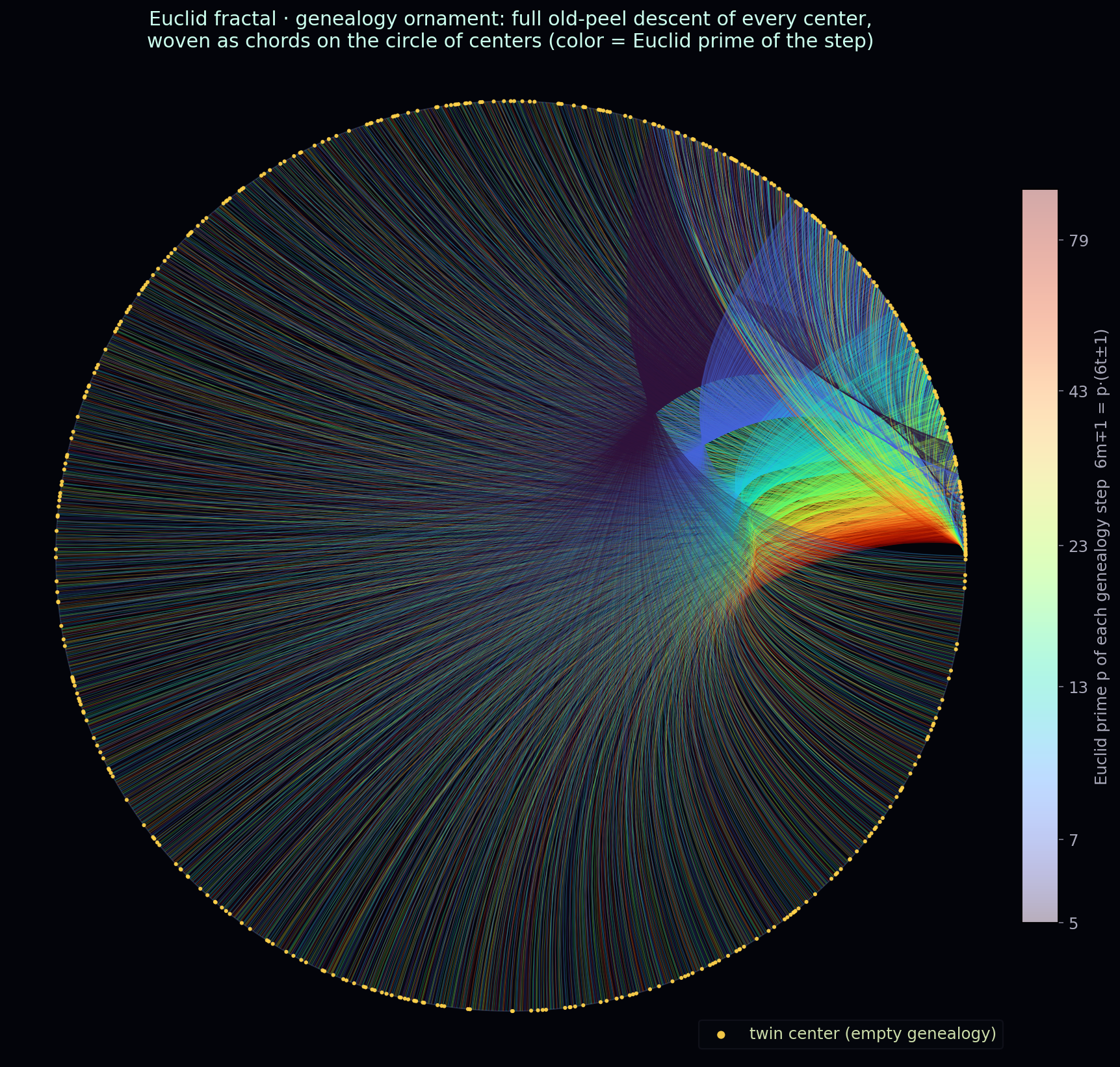
The fractal of Euclid's path · the genealogical ornament: the full old-peel descent of every centre, woven as chords on the circle of centres (colour — the Euclid prime of the step). All threads pull inward, toward the centres — a pattern of return, not of dispersal. The yellow dots on the rim are twin-centres with empty genealogy: those whose descent breaks off at once. It is precisely their infinitude that is the open line held by the first cause.
Generation algorithm (Figure 50.4). Source:
tools/fractal/euclid_fractal.py::genealogy_ornament(\(M = 4200\), \(\mathrm{PMAX} = 97\), \(\mathrm{DEPTH} = 10\)). Centres \(1, \dots, M\) sit on the unit circle at angle \(2\pi m/M\). For each centre the full old-peel genealogy \(m \to t_1 \to t_2 \to \cdots\) (to depth \(10\)) is built by the step \(6k\mp1 = p\cdot(6t\pm1)\): each step is a Bézier chord with control point \(\tfrac12(P_a+P_b)\cdot(1 - 0{.}92\min(2\,\Delta\theta,1))\), where \(\Delta\theta = |a-b|/M\) (long chords dive deeper toward the centre); colour by \(\log p\) (turbo). Twin-centres (empty genealogy) sit on the rim as golden points.
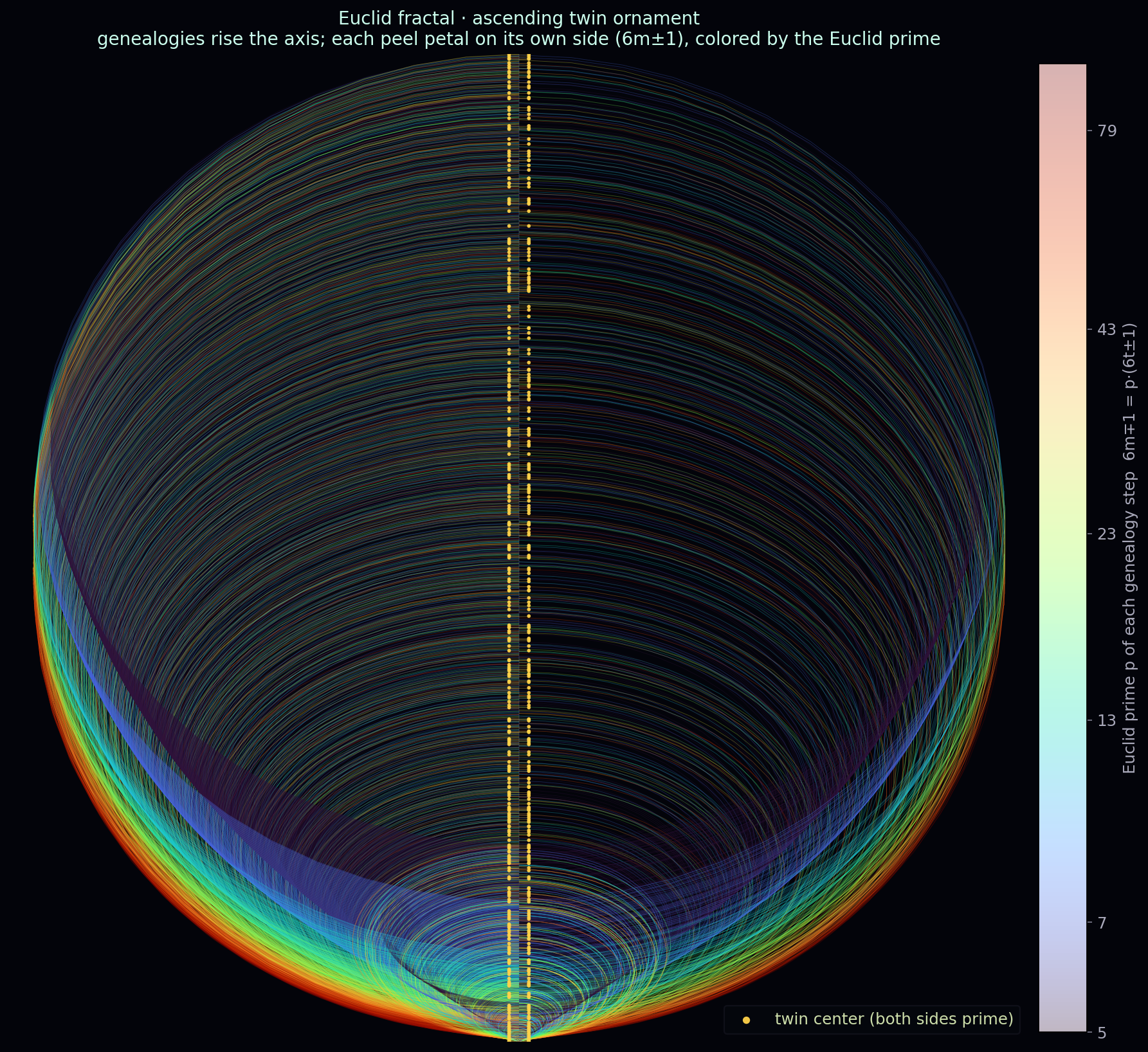
The fractal of Euclid's path · the ascending twin sphere: the same old-peel descent, but the line of centres rises bottom to top and each step is a petal on its own side (\(6k{+}1\) right, \(6k{-}1\) left; colour — the Euclid prime of the step). The petals are clipped to a circle of radius \(M/2\), so the ornament closes into a sphere; the golden double axis is the twin meridian, and the descent converges at the lower pole.
Generation algorithm (Figure 50.5). Source:
tools/fractal/euclid_fractal.py::ascending_twin_ornament(\(M = 3000\), \(\mathrm{PMAX} = 97\), \(\mathrm{DEPTH} = 14\)). Centres \(1, \dots, M\) rise along the axis \(x=0\) (height \(= m\)). Each old-peel step \(6k\mp1 = p\cdot(6t\pm1)\) is a semicircular petal from \((0, t)\) to \((0, k)\) bulging to the side of the peeled composite (\(6k{+}1 \to\) right, \(6k{-}1 \to\) left); the bulge \(b = \mathrm{band}\cdot\tanh(1{.}8\,a/\mathrm{band})\) with \(a = (k-t)/2\), \(\mathrm{band} = 0{.}55M\), is clipped to the circle of radius \(R = M/2\): \(b = \min(b,\, 0{.}985\sqrt{R^2 - (y_c - R)^2})\), \(y_c = (k+t)/2\) — so the ornament fills a sphere. Colour by \(\log p\) (turbo). Twin-centres (empty genealogy) are golden double sparks flanking the meridian axis.
What remains — and is worth it too
The synthesis closes here. The chapters that follow were added once the core was in place; they extend the reading rather than conclude it — and each stands on its own:
- 51. Numerical evidence — the counts and pictures beneath the claims: descent statistics, twin-centre density, the fronts made visible.
- 52. The dyadic model of fluid — Navier–Stokes stripped to its dyadic skeleton, where the blow-up question meets the engine head-on.
- 53. Birch–Swinnerton-Dyer — the eighth mask — the same descent on a real elliptic curve: a green descent-without-engine, plus one honestly named open input.
- 54. Neighbours beyond the horizon — open arithmetic problems that sit just past the same wall, where the reading points but cannot yet reach.
- 55. Collatz & 56. The Collatz first cause — the boundary walk in full: a decree taken and then withdrawn when its law was machine-refuted (n = 27) — and what honest defeat leaves standing.
← 49. Geometry of the path · Table of contents · 51. Numerical evidence →