13. The fractal layer and the model four-corner
← 12. Four-corner · Table of contents · 14. Remainder decomposition →
Lean source:
Engine/ModelFourCorner.lean(four_corner_binom,four_corner_binom_strict,model_four_corner). The file compiles;#print axiomsshows only[propext, Classical.choice, Quot.sound].
In the previous chapter 12 we reduced the statement about twin centres to the four-corner inequality \(N_{00}N_{33}\le N_{03}N_{30}\) and showed that its sign is rooted not in the density of primes but in the exclusivity of two: a prime \(p>2\) does not divide both sides \(6m\pm1\) at once (Engine/Carrier.no_large_shared_divisor, shared gcd ∣ 2).
There we worked with abstract rank counts \(N_{ij}\) and left one question open: where do these counts themselves come from, and why does the product over primes have no cross term \(xy\). The present chapter closes that question at the level of the model: we write out the rank generating function as a self-similar product, extract from it exact binomial counts, and prove the model four-corner — elementarily, without any distribution of primes, entirely in Lean.
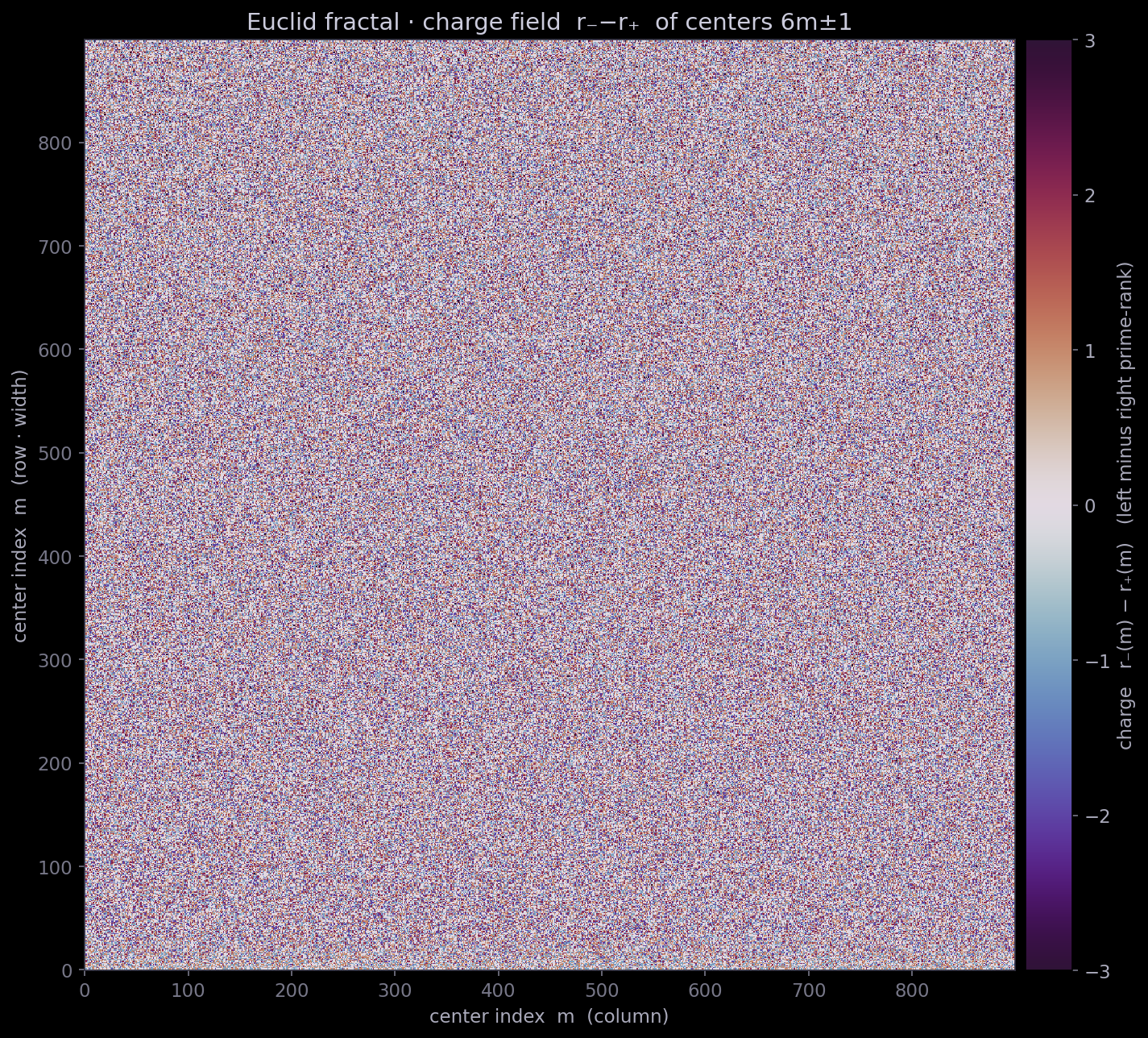
Fractal of Euclid's path · the rank field: the rank lexRank of each centre, coloured by layer — the
very self-similar generating function from which the four-corner grows. The self-similarity here is
contracting, not diverging: the pattern repeats on ever finer scales as one moves toward the
centre, rather than branching outward (more in the coda, chapter 50).
Generation algorithm (Figure 13.1). Source:
tools/fractal/euclid_fractal.py::rank_field. Parameters \(A=60\), \(W=900\); the prime layer is \(\{p:\ A<p\le A^2\}\). For each centre index \(m\in\{0,\dots,W^2-1\}\) two ranks are counted: \(r_-(m)\), the number of layer primes dividing the lower side \(6m-1\), and \(r_+(m)\), the upper side \(6m+1\). Technically, for each \(p\) the congruence \(6m\equiv\pm1\pmod p\) is solved: the inverse \(6^{-1}\bmod p\) gives the root \(r\equiv\pm 6^{-1}\pmod p\), the start offset \((r-1)\bmod p\), and a unit is added to every \(p\)-th position of the array \(r_\mp\). The "charge" \(r_-(m)-r_+(m)\) is imaged; the length-\(W^2\) vector is reshaped into a \(W\times W\) matrix (row \(=\lfloor m/W\rfloor\), column \(=m\bmod W\)) and drawn as an image with the diverging twilight-shifted palette (negative and positive charge at opposite ends, zero at the centre), lower origin.
The fractal generating function of rank
We begin with an observation about the structure of rank (on rank as the "height" of a state — see the glossary). By the rank of a centre \(m\) we mean the pair \((r_-,r_+)\), where \(r_-\) is the number of prime divisors of the lower side \(6m-1\), and \(r_+\) of the upper side \(6m+1\) (within the layer \(A\) under consideration). Each prime \(p\) of the layer contributes to the rank independently by CRT, and its contribution obeys two structural laws that we established earlier.
The law of \(\pm\)-symmetry. A prime's weight on the lower and upper sides is the same: the probability of landing in the class where \(p\mid 6m-1\) equals that of the class \(p\mid 6m+1\). This is exactly the mirror symmetry provided by the substitution \(m\mapsto -m\) (a swap of sides) — from the intuition of the engine (the perpetual engine — the forbidden infinitely descending chain, see the glossary), both sides stand on equal footing, neither is privileged.
The law of exclusivity. No \(p>2\) divides both sides: the classes \(p\mid 6m-1\) and \(p\mid 6m+1\) are incompatible. This is no_large_shared_divisor from 12.
From this it is natural to posit that the contribution of a prime \(p\) to the rank generating function is a factor
where \(x\) marks a divisor of the lower side, \(y\) of the upper, and the absence of \(xy\) is the direct reflection of the fact that "both at once" is impossible. The full generating function is the product over the primes of the layer:
Note. It is precisely the absence of the \(xy\) term that is the heart of the whole argument. In the general (non-exclusive) model the factor would be \(c+ax+by+dxy\), and the sign of the four-corner would not be forced. Exclusivity zeroes out \(d\) at every prime, not merely on average; this is a Diophantine property, not a statistical one.
The key self-similarity: the factor \(G_p\) depends on \(x\) and \(y\) only through the symmetric combination, so the product \(G(x,y)\) is a function of a single variable \(s=x+y\). In the equilibrium (homogeneous) model, where all \(n\) primes of the layer share a common weight \(w\) and a common constant term normalised to one, this gives
The expansion in \(s\) is the Maclaurin binomial:
From the generating function to the counts
The count \(N_{ij}\) — the coefficient of \(x^i y^j\) — is extracted from the coefficient \(Q_k\) of \(s^k\) by distributing the exponents between \(x\) and \(y\):
The factor \(\binom{i+j}{i}\) is the number of ways to scatter \(i+j\) chosen primes over \(i\) lower and \(j\) upper positions; this is exactly the "choice-within-choice" identity that will become the core of the Lean proof below. Substituting the corners of the rectangle \(\{0,3\}\times\{0,3\}\), we obtain
where \(\binom{6}{3}=20\) is the very constant that in 12 we denoted \(R_{\mathrm{CRT}}=20\,e_6/e_3^2\). The four-corner \(N_{00}N_{33}\le N_{03}N_{30}\) becomes
and after cancelling \(w^6\) — a purely binomial inequality:
The binomial four-corner: four_corner_binom
Definition 13.1 (model four-corner). By the model four-corner we mean the inequality
understood over \(\mathbb N\) (for \(n<6\) the left-hand side is trivially zero).
Theorem 13.2 (four_corner_binom). 🟢 For all \(n\in\mathbb N\), \(20\,\binom{n}{6}\le\binom{n}{3}^2\).
The proof is elementary and rests on the "choice-within-choice" identity. In Mathlib this is Nat.choose_mul:
On the left we choose \(6\) primes out of \(n\), then \(3\) of those six (for the upper side); on the right, we choose \(3\) out of \(n\) straight away, then \(3\) more out of the remaining \(n-3\). Both ways count the same thing — an ordered pair of disjoint triples — hence they are equal. Substituting \(\binom{6}{3}=20\) (decide in Lean) and \(6-3=3\), we obtain
What remains is the monotonicity of the binomial coefficient in its upper argument, Nat.choose_le_choose:
whence
In Lean the step _ ≤ _ is closed by the tactic gcongr (monotonicity of multiplication), the final equalities by ring.
Note. What this inequality means. The corners \(N_{00}\) and \(N_{33}\) (both ranks minimal / both maximal) cannot together outweigh the mixed corners \(N_{03},N_{30}\). This is precisely negative association of the ranks: high divisibility of one side repels high divisibility of the other. The cause is exclusivity: a triple of divisors "occupied" by the upper side is unavailable to the lower one, which is exactly what the transition \(\binom{n}{3}\to\binom{n-3}{3}\) expresses (the second side has three fewer candidates). We assumed nothing about how often primes divide the sides — only that they divide them mutually exclusively.
The model four-corner in the original coordinates: model_four_corner
So as not to lose contact with the rank counts (in which the weight \(w\) remains), the same inequality is also proven before the cancellation of \(w^6\), as model_four_corner.
Theorem 13.3 (model_four_corner). 🟢 For all \(n,w\in\mathbb N\), \(1\cdot\bigl(20\,\binom{n}{6}w^6\bigr)\le\bigl(\binom{n}{3}w^3\bigr)\bigl(\binom{n}{3}w^3\bigr)\).
theorem model_four_corner (n w : ℕ) :
    1 * (20 * n.choose 6 * w ^ 6) ≤ (n.choose 3 * w ^ 3) * (n.choose 3 * w ^ 3)
four_corner_binom): we multiply the inequality \(20\binom{n}{6}\le\binom{n}{3}^2\) by \(w^6\ge0\) (again gcongr) and regroup the factors (ring).
Conclusion. Substantively, this confirms that the weight \(w\) is a common positive factor which does not affect the direction of the four-corner; the sign is carried exclusively by the binomial part.
Strict positivity and the unreachable singularity: four_corner_binom_strict
The inequality \(20\binom{n}{6}\le\binom{n}{3}^2\) is non-strict, and equality is indeed attained — but only in the degenerate cases \(n\le6\), where the left-hand side vanishes. The substantive question is whether the inequality is strict on a non-trivial layer, where the ranks can genuinely reach three on both sides, that is, for \(n\ge7\). The answer is yes — four_corner_binom_strict.
Theorem 13.4 (four_corner_binom_strict). 🟢 For \(7\le n\) the strict inequality \(20\,\binom{n}{6}<\binom{n}{3}^2\) holds.
The proof strengthens the monotonicity to a strict inequality via Pascal's identity Nat.choose_succ_succ:
For \(n\ge7\) we have \(\binom{n-1}{2}>0\) (Nat.choose_pos), so together with the monotonicity \(\binom{n-3}{3}\le\binom{n-1}{3}\) we obtain
Since \(\binom{n}{3}>0\) for \(n\ge7\), multiplying the strict inequality \(\binom{n-3}{3}<\binom{n}{3}\) by \(\binom{n}{3}\) (mul_lt_mul_of_pos_left) gives
Note (the unreachable singularity). Denote the deficit \(D=\binom{n}{3}^2-20\binom{n}{6}\ge0\). Equality \(D=0\) would mean exact equilibrium \(N_{00}N_{33}=N_{03}N_{30}\) — rank independence of the sides, in engine terms an "idle run". The strictness of
four_corner_binom_strictsays: as soon as the layer is non-trivial (\(n\ge7\)), the system cannot settle on this singularity — \(D>0\) is forced. And this is exactly the strict positivity which in 12 yields not merely \(N_{33}\le N_{00}\) but the strict \(N_{33}<N_{00}\), and hence a guaranteed survivor.
What is proven, and what is not
Let us take honest stock. We have proven — machine-checked, elementary, distribution-free — that in the equilibrium symmetric exclusive model (the product of factors \(1+w(x+y)\)) the four-corner inequality holds always (four_corner_binom, model_four_corner) and strictly on non-trivial layers (four_corner_binom_strict). The sign is forced by a single structural cause — the absence of the \(xy\) term, that is, the exclusivity of two; neither the density of primes, nor a sieve, nor parity entered anywhere.
Conjecture (model \(\to\) reality). The real CRT rank counts coincide with the model product \(\prod_p(1+w_p(x+y))\) up to a remainder that does not flip the sign of the four-corner. The plan for closing it: write out the real factors \(G_p\) by CRT, show their \(\pm\)-symmetry and exclusivity at each \(p\) (the first from the mirror symmetry \(m\mapsto-m\), the second is the already-proven
no_large_shared_divisor), and estimate the accumulated remainder of the product. This is not a repackaging of the conjecture: the direction \(R_{\mathrm{fc}}\le1\) is already observed numerically on all blocks; only the control of the remainder remains open.
The model layer is the fractal "skeleton": a self-similar product yielding the exact binomial combinatorics of the corners. Reality differs from the skeleton by a remainder \(e_{ij}\), and its exact decomposition is precisely the subject of the next chapter 14 RealFourCorner: the real counts decompose as model plus remainder, the four-corner for reality reduces to the remainder not flipping the sign of the model one — and it is where the remainder swells against a melting gap that the line first runs into parity.
← 12. Four-corner · Table of contents · 14. Remainder decomposition →