Old-peel: catch as a step of descent
← 18. SNOL · Table of contents · 20. NOPSL →
Lean source:
EuclidsPath/Engine/OldPeel.lean(theoremscatch_is_opposite,old_peel_sign,old_peel_height_drop,no_infinite_old_peel,old_peel_terminates). Numbers:tools/RESULTS_oldpeel.md(3000 real rank-1 catches,A=200).
Where we are
In chapter 18 SNOL the whole programme was reduced to a single machine-fixed node —
the terminal shifted-neighbour obstruction at the carrier scale: if the twins are finite, then for
an active prime a > A the neighbouring side \(a-2\varepsilon\) is systematically caught by a small
prime \(p \le A\), which is written as the divisibility
$\(p \mid a - 2\varepsilon,\qquad p \le A.\)$
SNOL stopped precisely at the word terminal: the node was an honest reduction, yet it looked like a dead end — the divisibility is there, but what to do with it remained open. The present chapter closes this question.
We will show that the catch is not a terminal but a step of descent: it unfolds algebraically, gives birth to a new smaller centre and strictly lowers the height. Thereby the final SNOL node closes onto the impossibility of Euclid's engine already proven in [EPMI / Irreversibility] — with no counting and no distribution theory whatsoever.
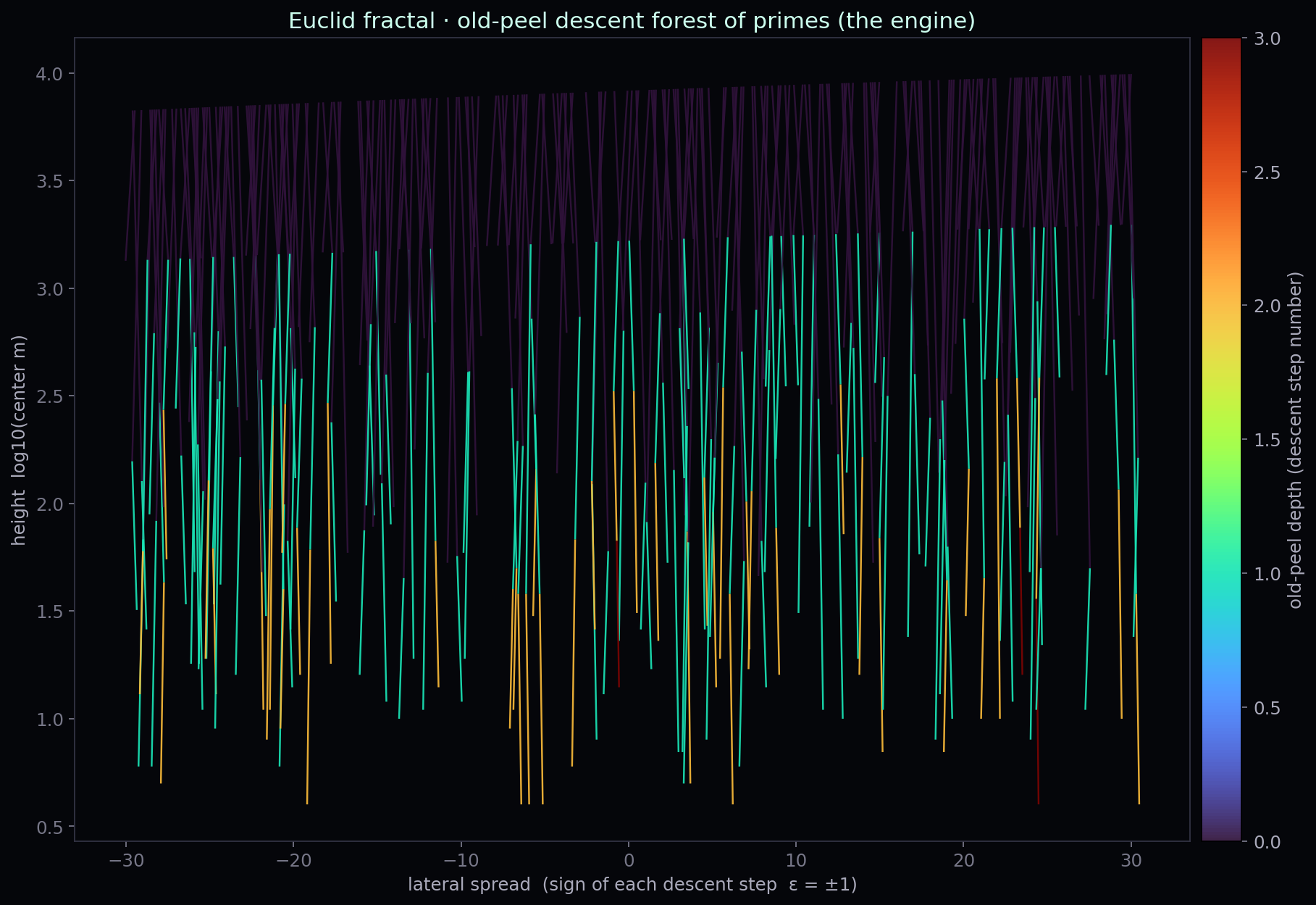
Fractal of Euclid's path · the old-peel forest: a tree of descents in which every catch is a step
down along a branch. The branches do not sprawl outward but converge to the root: every branch is
finite and breaks against the bottom — this is no_infinite_descent in a picture.
Generation algorithm (Figure 19.1). Source:
tools/fractal/euclid_fractal.py::old_peel_tree. Fix \(A=200\) and sieve all primes up to \(4A^2\); let the caught-prime pool be the primes \(p\) with \(3 < p \le A\). Seed a horizontal row of \(460\) roots at abscissae \(x\) evenly spaced over \([-30,30]\), the \(i\)-th root carrying centre \(n = \lfloor A^2/6\rfloor + 7i\). From each root run the recursive descent \(\mathrm{peel}(n,\varepsilon,d,x)\) for both signs \(\varepsilon=\pm1\): it stops when depth \(d>7\) or \(n<2\); it requires the side \(a=6n+\varepsilon\) to be a prime with \(a>A\); it takes the opposite side \(6n-\varepsilon\), finds the first pool prime \(p\) dividing it, forms the quotient \(q=(6n-\varepsilon)/p\), reads its sign \(\delta\) from \(q\bmod 6\) (\(\delta=+1\) if \(q\equiv1\), \(\delta=-1\) if \(q\equiv5\), and aborts otherwise), and sets the child centre \(t=(q-\delta)/6\) (aborting if \(t\le0\)). The step draws a segment from \((x,\ \log_{10}(n+1))\) to \((x+\varepsilon\cdot 0.55/(d+1),\ \log_{10}(t+1))\), then recurses into \(t\) with both signs at depth \(d+1\). Vertical axis is height \(\log_{10}(\text{centre})\); horizontal offset encodes the descent sign \(\varepsilon\). Segments are drawn as a line collection coloured by descent depth \(d\) through the turbo colour map, on a near-black background.
The catch is the other side of the wedge
We begin with an elementary observation that translates the SNOL divisibility into the language of the
engine. The active prime comes from a wedge centre n: one side of the wedge is the prime itself,
$\(6n + \varepsilon = a,\qquad \varepsilon \in \{\pm 1\}.\)$
The opposite side of the same centre is \(6n - \varepsilon\). A direct computation gives
Definition 19.1 (carrying the two). For a centre n with side \(a = 6n+\varepsilon\) the opposite side
equals
$\(6n - \varepsilon = (6n+\varepsilon) - 2\varepsilon = a - 2\varepsilon.\)$
This carrying is recorded formally as follows.
Theorem 19.2 (catch_is_opposite). For integers \(n,a,\varepsilon\), if \(6n+\varepsilon = a\) then
\(6n-\varepsilon = a - 2\varepsilon\) (in Lean — a single omega step). Hence the SNOL divisibility
\(p \mid a - 2\varepsilon\) is literally the divisibility of the opposite side of the wedge:
$\(p \mid a - 2\varepsilon \iff p \mid 6n - \varepsilon.\)$
Note. From here one sees at once why SNOL cannot be refuted by counting (as was already noted in 18): \(p \mid 6n - \varepsilon\) is not a rare coincidence but the norm for the composite side of the wedge. Catching a neighbour is business as usual; what must carry the substance is not the hit but what happens after it. Below we extract structure, not probability, from the hit.
Unfolding the catch into old-peel
Since p divides \(6n - \varepsilon\), the quotient can be written in the same wedge form \(6t + \delta\).
This is the central notation of the chapter.
Definition 19.3 (old-peel). The old-peel of an active centre n along a caught prime p is the
decomposition of the opposite side
$\(6n - \varepsilon = p\,(6t + \delta),\qquad p \le A,\ \varepsilon,\delta \in \{\pm 1\},\)$
producing a new centre t (the quotient centre) and its sign \(\delta\). The prime p here is
old (already present in the ledger — the bookkeeping of the programme's flows, see the glossary; \(p \le A\)); hence the name old-peel: we "peel off" the old
layer p and expose beneath it the smaller centre t.
Thus the divisibility ceases to be a dead end: it itself supplies the object of descent — the centre
t, smaller than n. It remains to prove three things: that the notation is sign-consistent
(the sign law), that it is genuinely smaller (the height drop), and that a flow of such steps cannot
be infinite (termination).
The sign law: δ = −π·ε
The sign of the new centre is not arbitrary — it is rigidly determined by the signs of the input. Let
\(p \equiv \pi \pmod 6\), \(\pi \in \{\pm 1\}\) (every prime > 3 gives \(\pi = \pm 1\)).
Theorem 19.4 (old_peel_sign). If \(6n - \varepsilon = p(6t+\delta)\), \(p \equiv \pi \pmod 6\) and
\(\varepsilon,\delta,\pi \in \{\pm 1\}\), then
$\(\boxed{\ \delta = -\,\pi\,\varepsilon\ }.\tag{19.1}\)$
Why. Reduce the decomposition modulo 6. From \(p \equiv \pi\) we write \(p = \pi + 6k\), whence
$\(p(6t+\delta) = \pi\delta + 6\big(\pi t + k(6t+\delta)\big) \equiv \pi\delta \pmod 6.\)$
On the other hand \(6n - \varepsilon \equiv -\varepsilon \pmod 6\). Hence -\varepsilon \equiv
\pi\delta \pmod 6, and since all three signs lie in \(\{\pm 1\}\), the congruence modulo 6 turns into
the equality \(\delta = -\pi\varepsilon\). This is exactly how the Lean proof is arranged: the
substitution \(p = \pi + 6k\), extraction of the factor 6 (hexp), reduction modulo 6 (hmod6) and a
case sweep over the eight sign combinations via omega.
Note. The sign law is no cosmetics. It says that the new centre
tis born with a predictable orientation, consistent with the orientation of its parent and with the class ofpmodulo 6. This makes old-peel a deterministic step of the ledger rather than a random factorisation: the next node "knows" in advance which side of the wedge it occupies. Numerically the law holds on 3000/3000 = 100% of real catches (RESULTS_oldpeel.md).
The height drop: t < n
Now the key point — that old-peel lowers the height. As the height of a centre it is natural to take
n itself (the order of the wedge).
Theorem 19.5 (old_peel_height_drop). If \(6n - \varepsilon = p(6t+\delta)\) with \(p \ge 5\),
\(\varepsilon,\delta \in \{\pm 1\}\), \(t \ge 1\) and \(n \ge 2\), then
$\(t < n.\tag{19.2}\)$
Why. Every prime \(p \le A\) caught at the carrier scale is a prime > 3, hence \(p \ge 5\).
Then \(6t + \delta = (6n - \varepsilon)/p \le (6n+1)/5\), from which, for \(n \ge 2\), immediately t < n.
In Lean this is a sweep over the signs \(\varepsilon,\delta\) followed by nlinarith on the
inequalities \(p \ge 5\), \(t \ge 1\), \(n \ge 2\) and the decomposition hpeel itself.
Numerically the descent is even sharper than the statement of the theorem: the harness yields t < n/5
on 3000/3000 = 100% (the factor \(p \ge 5\) eats away at least a fifth of the height in a single
step). The theorem proves the soft, reliable bound t < n; the observation t < n/5 is its empirical
strengthening.
Note. Here is where the terminal turns into a descent. The SNOL divisibility
p \mid
a - 2\varepsilon
is not a "wall" against which the active prime shatters, but a step downward: every catch sends us to a strictly smaller centret. The regeneration of the flow (thatt > 0, the flow continues rather than collapsing to zero) is likewise confirmed on 3000/3000 = 100%.
Why the descent is a contradiction: the old engine
Let us assemble the three laws into a single dynamical conclusion. Suppose, contrary to SNOL, that
there is no terminal, i.e. for every active centre its catch unfolds by an old-peel (regenerate —
see 20). Then from any starting point one builds a sequence of centres
$\(z_0 > z_1 > z_2 > \cdots,\qquad z_{k+1} = t\big(z_k\big),\)$
where every inequality z_{k+1} < z_k is given by Theorem 19.5 (old_peel_height_drop). This is an infinite
strictly descending chain of natural heights — and that we have already forbidden in Euclid's
engine.
Theorem 19.6 (no_infinite_old_peel). For any \(z : \mathbb{N} \to \mathbb{N}\) with the property
StrictAnti z, False follows. In Lean this is literally no_infinite_engine_descent z hdesc —
the old-peel height is used as the very same Lyapunov chain that drives the engine's downward motion
into contradiction.
Theorem 19.7 (old_peel_terminates). If \(\forall k,\ z(k+1) < z(k)\), then False
(via strictAnti_nat_of_succ_lt and Theorem 19.6 (no_infinite_old_peel)).
What is proven and what it means. Machine-verified is the closure core: any infinite strictly
descending old-peel chain of centres yields False. The contraposition reads directly: an old-peel
flow must stop somewhere — run into a twin sink or return to the ledger by a clean return. Otherwise
it would ride downward forever, which is impossible in \(\mathbb{N}\) and forbidden by the already
proven impossibility of the engine (no_infinite_engine_descent, [EPMI / Irreversibility]).
Conclusion. The final SNOL node closes not onto a new distribution theorem but onto the old engine — this is the whole gain of the chapter.
Honest audit: where the input remains
Proven in Lean:
- the entire old-peel algebra — carrying the two catch_is_opposite, the sign law old_peel_sign,
the height drop old_peel_height_drop;
- the closure core — infinite strict descent ⟹ False (no_infinite_old_peel,
old_peel_terminates).
Numerically, on 3000 real rank-1 catches all three empirical laws hold at 100%: the sign law
\(\delta = -\pi\varepsilon\), the height drop t < n/5, the regeneration t > 0. Old-peel is a real
mechanism, not a hypothesis: it is observed at every checked node.
What remains open is one structural (not counting-theoretic) input — in the programme's terms a
gate: an honestly named unproven statement still missing on the way to the goal (see the glossary).
To turn the contraposition into a complete
proof, one needs to know that the quotient centre t is always classified — falls into one of the
permitted categories rather than into a hidden "unclassifiable terminal":
Conjecture 19.8 (old-peel regeneration, NOPSL). For every non-sink centre t its catch unfolds into a
correct old-peel successor, i.e. t belongs to one of the categories:
- clean return (\(t \in \Omega_A\); for
t < A^2— a twin sink);- the next old-peel (\(t \notin \Omega_A \Rightarrow \exists\, q \le A,\ q \mid 6t + \eta\));
- fan-in / Hall (several lineages converge into a single
t);- an already classified defect.
Closure plan. Show that the extended rigid-ledger is closed under old-peel quotients: applying
old-peel does not take a centre outside the classification and does not introduce a hidden cycle at
the t-node (the central point of the audit). This is in principle not a counting input — unlike
the former four-corner H, it calls neither Mertens nor the distribution of shift divisors, but lies
within the same logic of the engine's impossibility: "the flow has nowhere to go but down or into a
twin".
Bridge to the next chapter
We have unfolded the final node of 18 SNOL into a strict descent and closed its core onto the proven
engine. Exactly one premise remains — the regeneration regenerate: that the old-peel flow cannot
forever evade a correct sink. In chapter 20 NOPSL we formalise this premise by the abstract
structure OldPeelLedger (height, sink, step, step_drops, regenerate) and machine-prove the full
closure \(OldPeelLedger \Rightarrow \mathrm{TwinLowers.Infinite}\) through the same strict-descent
logic — thereby carrying the entire SNOL/NOPSL reduction from prose into verified deduction.